
The Death Gene
 Thursday, November 5, 2009
 Is death an acquired trait? We like to think of death as unavoidable. We believe that all things must die. It makes our own mortality easier to bear. Yet single-celled life forms don’t necessarily ever die. They can beat the odds and indeed every surviving amoeba on earth has been alive billions of years.
So maybe death is not inevitable and is just an evolutionary trait. Death may be a competitive advantage devised by multi-celled life forms. That seems pretty counter intuitive. After all, the purpose of life is to live, right? Death must be life’s unavoidable antagonist, an environmental villain that life strives to overcome, that evolution or intellect may one day conquer. But what if death is something that our distant ancestors created, a necessary evil that helped them better compete with immortal species? What if death is not even a necessary evil, but beneficial?
What is a Death Gene?
If it exists, the death gene would be DNA programming that limits our life span. Something that makes a species’ dying much more predicable than random accidents otherwise would. Evidence of this is all around us. Most insect species live a season at most. Dogs are good for ten to fifteen years. We live 60 to 100 years (though probably without modern medicine, 40 to 70 years is closer to our natural genetic programming). Some turtles live much longer than we do even without medical technology. Some species of trees live many hundreds of years and there are redwoods over 2,000 years old.
Still, maybe environmental or anatomical constraints determine life spans? After all, most insects are not capable of living through a cold winter. Maybe it is the seasons that kill them and not their own genetic programming. But what is so different between dogs and humans that humans deserve to live five times longer? Nothing that I can see. We just do because our DNA tells us to.
About five years ago, scientists in Scotland found a genetic sequence on our fourth chromosome that may stop cells from “living and dividing infinitely” after their allotted life span. Such a gene is thought to be crucial in controlling cancer. “Cancer cells have various defects that keep them alive and allow them to divide well beyond their allotted life span.” Cancer may be caused by a defect in our death gene. Without cellular death, complex multi-celled life cannot exist.
Evolution Speeds Up
As far as we know, life appeared soon after the Earth formed about four billion years ago. During the next three and a half billion years, cells grew more complex internally and discovered photosynthesis (which incidentally filled the atmosphere with oxygen, the most toxic pollution of all time). But change was slow and life remained single-celled and tiny. Then just over half a billion years ago, multi-celled life appeared and evolved very quickly in complexity and size.
The Cambrian explosion is paleontologists’ term for fossils of diverse complex animals that appeared rather abruptly around 530 million years ago. Precursors of modern mollusks seem to have appeared first, followed by arthropods and other phyla, precursors to all of modern fauna. About 10 million years of evolution seems to have produced more change than all the preceding eons, hundreds of times longer.
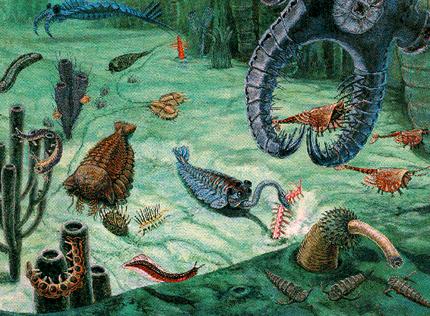
Why did diversity explode just then? One theory is that it didn’t. Maybe life had become complex much earlier but was just too small to see in our fossil record. Fossils are made of rock and rock is made of crystals. A crystal is the minimum “pixel” size of a fossil image. And of course soft bodied animals would not fossilize well. And there is some disputed fossil evidence of multi-celled life before the Cambrian, though not much before 600 million years ago.
Maybe Death Helps Life to Compete
Still, the consensus seems to be that evolution was somehow accelerated during a fairly brief Cambrian epoch, just over 500 million years ago. To me, it seems likely that this “explosion” was due to something newly evolved, some competitive mechanism that allowed life to both spread and change more rapidly than ever before. The jump to multi-celled animals must have been a high hurdle for evolution, one that probably needed a catalyst. Once evolution discovered that catalyst, diversity exploded. Then competition from all those newly evolved phyla must have quickly throttled back the rate of change.
The catalyst may have been genetically programmed death. Independent single cells die, but they don’t have to. Those individuals that survive effectively live forever. Contrast that to us. No one has probably ever lived longer than about 120 years. And that implies that none of our cells has either. Except for the germ cells, the eggs and sperm that keep our DNA alive between generations. But germ cells don’t really count except for their DNA.
How would death help life to compete? It might just be a side effect of the need for cells to cooperate in a multi-celled organism. Fundamentally designed for independent existence but harnessed together into a cooperative whole, cells probably require death as a throttle. Cancer is the design flaw that results when you build life out of individual cells. Genetically programmed death is the tool that (mostly) controls it.
Possibly our DNA has acquired built-in counters at the end of our chromosomes that are snipped off with each reproduction. When the counter reaches zero, reproduction stops and death is inevitable. Without this counter (and probably other throttles as well), cancers occur and bodily tissues stop cooperating. Multi-celled life uses death to harness independent cells that are still inclined to compete with each other.
But death probably serves life in another important way. Frequent death should speed up evolution. It forces more generations in a shorter period than natural environmental hazards might. With more generations, we have more chances to evolve random but beneficial new traits.
When I first heard of the Cambrian explosion, I naturally wondered what could speed up evolution so dramatically? I believe death is the likely answer. And if evolution did suddenly speed up, that implies that death as a genetic trait might have first evolved just prior to the explosion of multi-celled life forms half a billion years ago. That makes death a relatively new idea, an advanced concept that took billions of years to evolve.
Consequences
Programmed death has something in common with sex. Both are fundamental to complex life. Nearly all higher plants and animals use them and so the evidence is strong that they are highly useful competitive tools. Sure, sex is pleasant and death is not. But when you think about it, both sex and death are unselfish acts that inconvenience the individual for the benefit of the species (or at least its DNA). As much as we enjoy sex, one wonders whether twenty years of parental servitude is a cost worth five minutes of pleasure. Sex and its consequences are enjoyable because rewards work better than punishment and our genes know that. But death allows for no reward. I’m sure our DNA would reward the act of death if needed. But nature needs nothing further of us afterward and so no reward mechanism has evolved.
DNA is really the soul of life. And DNA remains immortal, at least from our limited perspective. Our mortal selves and even our mortal thoughts and self-awareness are really just expendable tools of a higher life form: our genes. Maybe there really is a god. Maybe life’s DNA is a scientifically verifiable deity. A god that does indeed hold our lives and our destiny in its hands. Like our parents, we owe everything we are to this god. But like our parents, we are often in conflict with its goals. There is certainly conflict in this death thing. Our DNA wants it and we don’t. Godlike DNA wins.
I’ve argued that death may be genetically programmed rather than inevitable. That death allows our DNA patterns to more successfully survive and evolve. Of course, death is not in our personal interest, at least individually. And it seems to me that the existence of death causes a lot of unforseen social consequences. After all, society is a mechanism that allows otherwise competitive individuals to cooperate. But who cares about cooperation when we are all dead in the long run? Genocide, wars, murder and all of the other human-created ills we face would not be in our best interest if we planned on living forever. But being mortal, short term accomplishments are all that really matter.
Bad for the individual and dangerous for society, should we eliminate death if we could? Probably not, unfortunately. Destructive as it is, death is also the soul of human motivation. What would we ever strive for without it?
Reader Comments (17)
I would say that death is a necessary evolutionary trait, not to speed up evolution (i dont see why it would force more generations, i think breeding occurs the same, and natural death is not selective of fitness (except those who will naturally live longer but that would mean the opposite to death as an aid to evolution)) But i do think it serves a purpose in preventing overcrowding, if we all lived forever wed exhaust all our food sources, and would have to resort to canibalism, and as all our food sources would be unrecoverable, wed either eat and wipe ourselves out or reach a maintainable equilibrium of canibalism.
Hello,
My background is Bioinformatics and Computational Biology.
Yesterday night I could not fall asleep because I was thinking about exactly the same thing. Just like that, nothing pointed me really to it. Never heard about it before... And I think I figured out mathematically why death was a beneficial trait and I think I can prove it by computer simulations of populations. Don't know if you've already done that. Now that I've searched for this thing and found your blog I am REALLY excited!
Thanks for your comments.
I'm not a biologist or a medical person and am not an expert on cancer. But it seems to me that one of the fundamental "goals" of cellular life must be to reproduce. Reproduction is the trick that allows life to succeed. But unbridled reproduction suddenly switches from being purely beneficial to being possibly harmful once cells join together to form multi-cellular life forms such as ourselves. So while no one really knows why cancer exists, it seems likely to me that multi-cellular life forms have developed reproduction inhibitors that allow the individual cells to cooperate rather than compete. Probably it is when those inhibitors break down in just one cell, it is free to reproduce in an uncontrolled fashion, growing into a cancer. It seems to me that such uncontrolled reproduction is probably pretty much the way our single-celled ancestors did things before they evolved into multi-cellular life. Life usually evolves by adding new mechanisms on top of the old. So it seems to me that multi-celled life added growth inhibitors, but that the old reproductive ways are still buried underneath. That cancer is little more that those old reproductive ways showing through, allowing a single cell to start competing with its neighbors.
My conjecture that death allows for more generations is a guess. I am not sure it is true, though my thesis depends on it. Here is how I would argue that it is probably true.
Imagine an environment with room for only a fixed number of individuals, say 1000. And imagine that these individuals can live forever unless they are killed by competition or the environment. Assume that competition and the environment have a 10% chance of killing any individual in a given unit of time, say one year. That would give a ten year average life span. Of our 1000 individuals, 100 would die each year and be replaced by new reproduction. I assume that mature individuals have a competitive advantage over the young, so if there is only room in the environment for 1000 individuals, the excess young would die rather than mature individuals. So we would have only 100 new births each year that survive and only 100 new rolls of the genetic dice toward evolving new improved forms of life.
Now let's assume that our individuals have genetically programmed themselves for a limited life span. Assume that in addition to the hazards imposed by the environment and competition from other individuals, each of our individuals has a 40% chance of dying of old age each year. That would give individuals a much higher chance of dying, say 50% per year (10% from the environment and 40% from preprogrammed death). Half of our population would die each year. So 500 new births each year would survive, five times as many using my assumptions. With more new births that can survive each year, evolution would have more chances per year and new traits could change faster. So species with preprogrammed death could evolve faster and compete better with other species without "old age" death. Death would become a beneficial trait.
Maybe your possible computer simulations would be similar to this argument or maybe you have a better simulated proof?
hello.
i know somthing about biology. As far as i know there is no exact explanation for the meaning of DEATH, and till now some things are remaining puzzles...
iam a Muslim i believe in the presence of Allah and the power of Allah (God), that contol everything. and the death is inevitable and after death there is the day of judgement.
thanks for your good explanation...
Can someone guide me to somewhere that has some information on "death gene" research? This is the only thing I can find and I want to read about these scientists in Scotland
The link I found in 2007 appears to have been unstable and no longer brings up that 2002 "Scientists home in on death gene" article. However, some searching on the site found the same article under another URL and I've updated the "scientists in Scotland" link in my post above to point here: http://info.cancerresearchuk.org/news/archive/pressrelease/2002-11-10-scientists-home-in-on-death-gene
Nice one. Whats happenin with you in 2010?
I currently study science, mostly human biology, at university and I'd like to say there are massives flaws in your theory.
How does dying speed up evolution?
You said it is because it forces more generations. But look at the examples that you yourself have used. Unicellular organisms (such as amoeba or bacteria. Amoeba being the example you used)
They have been said to have evolved at a extremely fast pace yet they can potentially live forever. See, logically, it isn't a fast death rate that would speed up evolution but a fast reproduction rate.
A death gene would not be beneficial or speed up evolution, but rather probably something more like; earlier reproductive ages, more offspring, would.
Actually, look at the cheetah. It is going extinct because it has failed to conserve its genetic variation. If, for arguments sake, there was a cheetah with genetic material from 2000 years ago, the cheetah will survive, but currently it probably won't. Its the same with many other animals.
The death gene, if anything, would slow evolution, as it would mean the loss of past genetic information which maybe, and very often is, useful for future generations but have failed to be past on.
I mean no offence, but I personally think, an article like "the teenage pregnancy gene" would make more sense and be more logical than this article.
I think Tim's comment didnt need to be so aggressive. Especially the last bit.
But i think his idea makes sense. Except the last bit.
To the author; i dislike your ending of the article. Its very philosophical. Its a dog eat dog world out there. Civilisation is too young and I'd think that bit was a bit out of place.
I have read many books to late (DNA, Evolution, Darwin etc..). I clearly see that the only guessing game in this comes from a shaky belief in Evolution, and not creationism. I believe we are programmed to die, it most likely is in the 4th chromosome of most people, much like the 11th chromosome houses many traits that are proven to be of criminal actions by mutation of genes of the 11th chromosome. Even studies in mice (IE DNA, second to last chapter). Mice that appear identical, but have habituated in very different regions for thousands of years, yet look identical, one is sexually monogamous, one is "promiscuous". So of course, the Darwinian way of thinking would hypothesis, YES there has to be a death gene, as all that we are and do is directly a result in our genes. I wont get into Eugenics, or myostatin mutations but there are many things to be considered, death makes us god like, but this is a myth taken from ancient peoples, so what exactly is god like? I would like to see the 40% of science that believes in creationism to become 0%, then we would make twice the headway in discovering how to bypass this death gene...which I believe can and will happen in the not so distant future, if society can get along and stay consistent (again all religious views that lead to violence world wide).Stop the folklore and put 100% into total beleif of evolution, why do you hold out, no god will save you, you have learned this time and time again in life, so why would god save one from death, god wont, BUT WE AN SAVE OURSELVES
I enjoyed this article very much. Keep up the good work and please let me know about anymore hypothises that you might have. Thanks.
LOVED the article. Very well thought out and easy to understand where your ideas were coming from. I only have 1 argument to make :)
You said your thesis is that older generations would live while the younger less experienced generations would die. If a population cap was true this might very well be the case but overpopulation has never, to my knowledge, really played a role. As I see it as one species starts to grow in population another species will step in to eat it. Not because it evolved to hunt that particular animal but because the increasing population means it is a more readily available food source. Both species are genetically trying to increase their population.
My thought is that death is there to prevent older generations from corrupting the evolution of the new generations. Lets say each generation increases their genetic adaptations by X traits. Your kids will have X new traits, their kids will have 2X more than you and so on. Your great great great great great grandchild will have a LOT more adaptations than your child. They will have gotten rid unnecessary or harmful traits and created new beneficial ones.
So if you and your mate lived to be 1,000,000 years old and had another child that child would NOT be adapted to that world. They would be genetically adapted to a world from a million years ago. Things would drastically have change in a million years and they most likely would not be well suited to survive in it. Similarly if you were to mate with someone from the current generation you would give that new child all of your old outdated traits that could potentially lessen their chance of survival.
If we die before too many generations have passed than our outdated genetic material cannot 'taint' the newer more adapted versions.
At least that's what my fortune cookie said :D I even learned how to say 'Soy sauce' in mandarin.
Lots of interesting info to read, howqever, i believe that you are all missing something,
Ok, The Planet earth is a LIVING ORGANISM, the human race rather than interact with the earth, does in fact do the opposite, by raping the earth of her own life sources, in response to humanity's taking more than we need, the earth heals herself over millenia , thus creating new life and new organisms , and in order to do that she needs to rid herself of that which takes and does not put back or work in harmony with her ,
so irrespective of religious beliefs, scientific theory,biology, etc etc , look at the basic and simple facts first , when the human race is in agreement with the nature that supports all living life forms , perhaps then we will have longer life spans , .
It will not take another million years for humans to evolve into a higher being. Human’s evolution is almost non-existent in its status quo. Death eventually will be optional since we are the creators. Perhaps another 50-100 years nano Tec will allow us the next leap in evolution a self-created evolution. Maybe then people will stop living for today and think about tomorrow.
A very interesting post with a good argument for a "death gene".
In my recently published book "Nothing Matters - a book about nothing" (iff-Books), I move along the same lines and go a little further by positing a "nothing gene".
Bearing in mind our certain mortality, it is interesting that every religion, belief, faith and cult have a common denominator: the denial of nothing, ie. the non-acceptance that death is the end.
With non-believers, it is not the denial of death, but the impossibilty of inderstanding what it is to be dead, i.e. to not be. We know what it is to die, since we know that it will happen. And we know that there is death. But the being dead is an imponderable.
Alongside the "death gene", that limits our life span, "the nothing gene" allows us to simply not face a future reality that is the total absence of self. As an evolutionary tool, it complements the "death gene" and makes it bearable albeit conceptually non-touchable. As an evoloutionary tool, it simply alows us to carry on living.
Speak for yourselves, guys! People like Ray Kurzweil (http://en.wikipedia.org/wiki/Ray_Kurzweil) and "The Immortalists" plan to live forever. In fact, they already have a date for introducing a 'cure' in the form of simple genetic manipulation (injection or pill) that would not only kill the death gene but also reverse the process of aging even if you're 70 years old. Fact or fiction? Would those who laugh at them now not buy the panacea IF it's available over the counter? Will we then overpopulate Earth or would we finally go for a glorious space exploration that would allow us terraform other planets to accommodate the unaging human race? Well, I explore all this from a sci-fi point of view, so don't kill the messenger ;-) Just come and check out my short stories, which explore it in the spirit of The Outer Limits. I certainly hope my comment won't disappoint those who plan to have a great funeral and already have purchased an expensive lot in a serene cemetery.
Godspeed!
Yes it could be an emerging new era and direction of genetic researches.....